As context, when I started my senior year of high school in 1960, Dwight Eisenhower was president. He was, and—to a large extent—still is, my ideal of a president. The quintessence of patriotism, a public servant in time of peace and in time of war. A student of world history and military strategy. His diplomatic skills enabled him to coordinate efforts with de Gaulle and Montgomery in a collaborative effort to defeat Nazi Germany.

On January 17, 1961, in this farewell address, President Dwight Eisenhower warned against the establishment of a “military-industrial complex.”
https://www.archives.gov/milestone-documents/president-dwight-d-eisenhowers-farewell-address
“A vital element in keeping the peace is our military establishment. Our arms must be mighty, ready for instant action, so that no potential aggressor may be tempted to risk his own destruction. . . . American makers of plowshares could, with time and as required, make swords as well. But now we can no longer risk emergency improvisation of national defense; we have been compelled to create a permanent armaments industry of vast proportions. . . . This conjunction of an immense military establishment and a large arms industry is new in the American experience. . . .Yet we must not fail to comprehend its grave implications. . . . In the councils of government, we must guard against the acquisition of unwarranted influence, whether sought or unsought, by the military-industrial complex. The potential for the disastrous rise of misplaced power exists and will persist.”
In 1961, as I bid farewell to the comfort of a suburban home and left to attempt a college degree, I looked back on my religious heritage: Best of God / Worst of God.
My father’s oldest sister, Aunt Madeline, had—somehow—managed to combine the spirit of Christ’s teachings with an unwavering commitment to the Catholic Church. She tutored me in Latin (before the Mass was celebrated in the vernacular…) She exemplified the integration of an ethical perspective and a successful career.
My window, via TV, into spiritual truth (yes, early television included broadcast of religious programs with an overlay of rational thought) was the weekly program of Bishop Fulton J. Sheen. (Current version has been colorized – I miss the original black and white.) His enthusiastic effusive energy in non-proselytizing sermons invariably presented ways to integrate Christian values into the 20th century.
These inspirational people were a reassuring counterbalance to the rigid and formulaic efforts at indoctrination in my catechism classes. Madeline and Bishop Sheen were honest representatives of a devotional life. Not the dull and dishonest nuns and priests of my month-long Catholic summer camp experience. (I returned home still a virgin, mercifully unaware of the clerical abuse of young boys. And deceitful coverups by Bishops.)
The calculated hypocrisy of the Church set me on a life-long journey to find spiritual truth outside traditional institutional boundaries.
As I’ve taken time in retirement to contemplate ways to make sense of eight chaotic decades, I see a warning comparable to Ike’s military-industrial complex concern. I see in the Abrahamic traditions, a military-ecclesiastical complex—the coupling of revealed religion with political and military might.
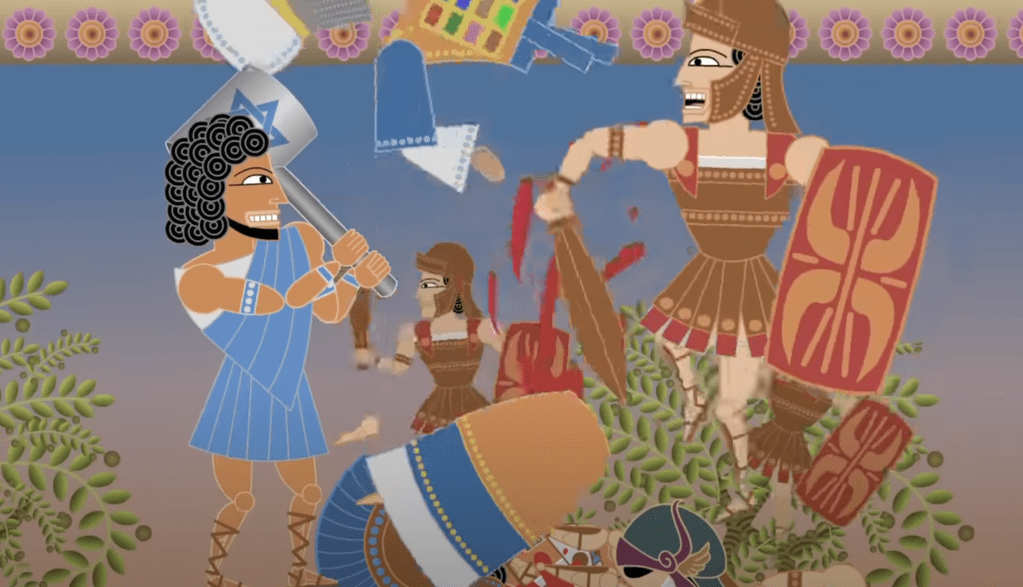
This intersection is not too bad in Judaism. It appears to be God Himself (or Herself) who wipes out Pharoh’s Army as the Red Sea collapses in on itself, drowning an entire army. But, as the followers of Moses journey through the desert, they gain enough strength to, when they arrive at the Holy Land, following God’s exhortation kill the then-current inhabitants.
In Christianity, all goes well until the Council of Nicaea in 325 AD. In essence, the Christians pledged that Christ would protect the Roman Emperor Constantine in return for his military efforts to protect the Christian community. (And to resolve aspects of the theology regarding the Trinity…)
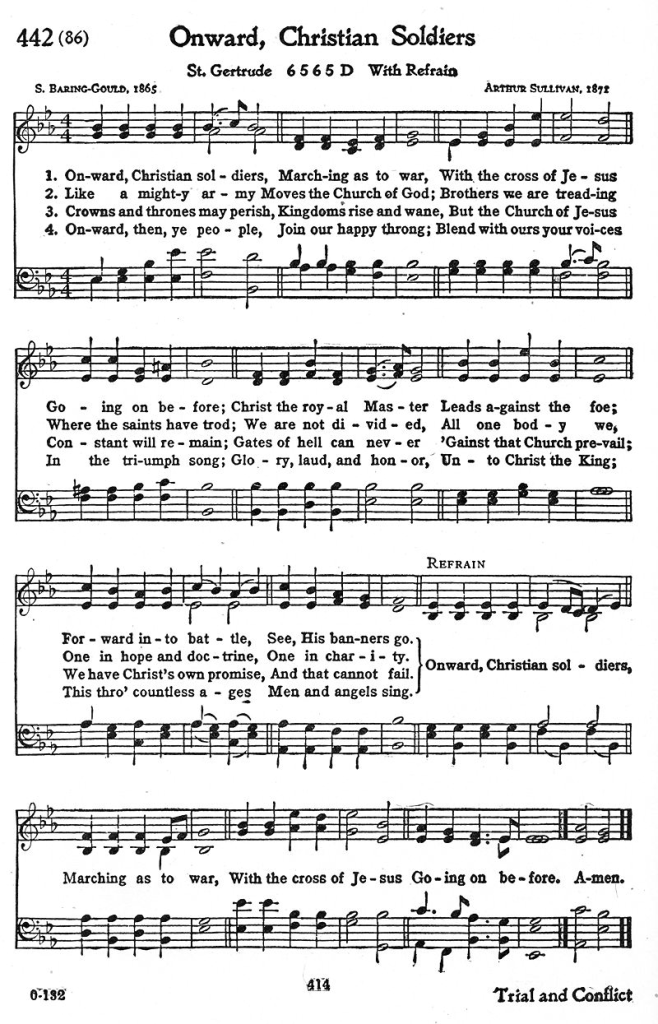
I remember singing Onward, Christian Soldiers and wondering about metaphor vs. reality.
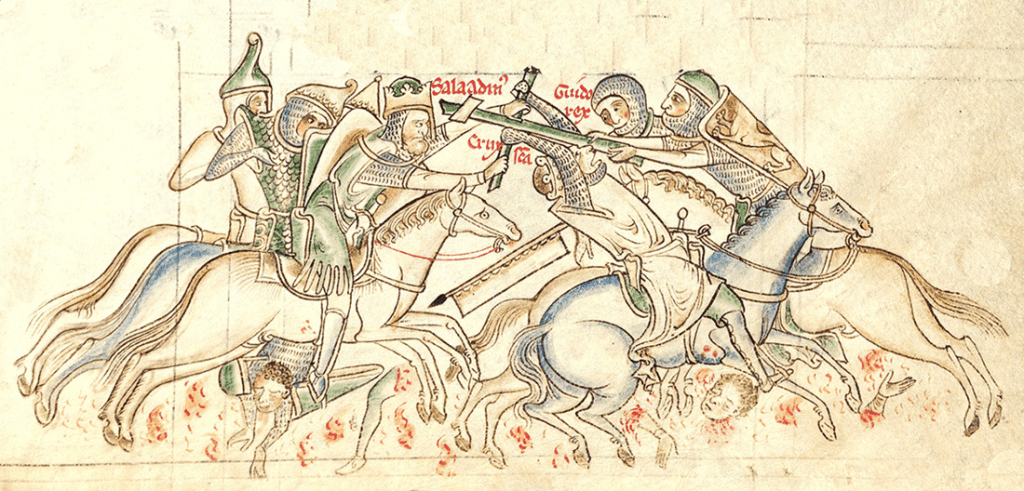
With Islam, at the death of Muhammad, the question of succession arose: did we want a spiritual leader (Ali, son-in-law of the Prophet) or a military leader (Abu Bakr, Muhammad’s chief military strategist and the first caliph). Although Muhammad forbade spreading Islam by the sword, the Islamic conquest of southern Europe was a natural consequence of a militarized culture/religion. And a catalyst for the Crusades.
I’ve often wondered about the extent of death in secular wars vs. death in ecclesiastical wars. But given the lack of separation of culture/state/religion until modern times and given weapons of mass destruction in our secular age, the question seems beyond a clear answer. Was the Nazi Holocaust an integral part of a secular war? Religious persecution addendum?
For a religious tradition with “Thou Shalt Not Kill” as a core commandment, the loyalty of Abraham to the demand of God (“Yes, Lord, I will kill my own son for you.”) suggests a Deity with violent tendencies and followers with pathological fealty. Ostensibly, we are created in the image of that Draconian God.
The current global investment in the military-industrial complex suggests that Eisenhower’s warning was appropriate. My anti-war colleagues from the 1960’s labored during the Cold War with its proliferation of nuclear weapons, under the long historic shadow of national identities formed in the wake of the Crusades—Islamic Jihad and Christian re-conquest.
As we watch holy zealots in the Middle East (Netanyahu in Israel, The Grand Ayatollah Sayyid Ali Khamenei in Iran, and the leadership of Hamas in Gaza), the ecclesiastical-military complex seems a likely epicenter for WW III. The ongoing war between Russia and Ukraine appears to be a similar catalyst for a secular obliteration.
The evolving competition for scarce resources, resources inadequate for rapacious populations in an age of climate change and mass migration, pushes the global community toward belated adoption of inadequate responses—with the likely occurrence of the 6th Extinction.
If we are to avoid that Absolute Worst of Times, perhaps we need the non-violence of Gandi’s personal example combined with a modern instance of religion without an aggressive need for conquest.
In 1985, the World Centre of the Bahá’í Faith published a Statement on The Promise of World Peace which has been an elusive goal for mankind throughout recorded history.
The statement begins:
The Great Peace towards which people of goodwill throughout the centuries have inclined their hearts, of which seers and poets for countless generations have expressed their vision, and for which from age to age the sacred scriptures of mankind have constantly held the promise, is now at long last within the reach of the nations. For the first time in history it is possible for everyone to view the entire planet, with all its myriad diversified peoples, in one perspective. World peace is not only possible but inevitable. It is the next stage in the evolution of this planet—in the words of one great thinker, “the planetization of mankind.”
In a note of profound realism, the statement continues:
Whether peace is to be reached only after unimaginable horrors precipitated by humanity’s stubborn clinging to old patterns of behavior, or is to be embraced now by an act of consultative will, is the choice before all who inhabit the earth. At this critical juncture when the intractable problems confronting nations have been fused into one common concern for the whole world, failure to stem the tide of conflict and disorder would be unconscionably irresponsible.
The underlying theme prescribes the development of a collective will to tread a spiritual path with practical steps. Perhaps this is a vital proclamation that the Best of Times is still possible.
Full Statement:
https://www.bahai.org/documents/the-universal-house-of-justice/promise-world-peace
 Best of Times, Worst of Times