Why did Al Capone go to prison? Murder? Planning and coordinating murders? Prostitution? Running organized prostitution rings? Racketeering?
None of the above! Although it was well known that his empire encompassed racketeering, prostitution, and murder.
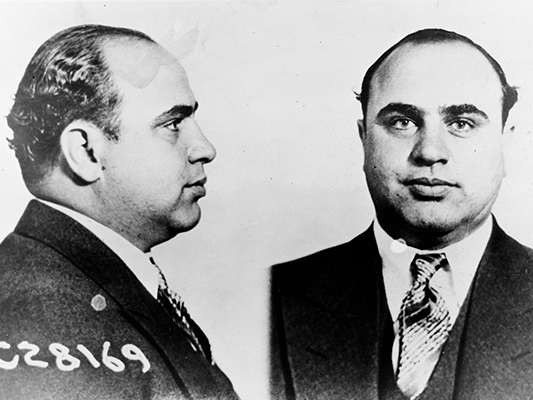
“On October 17, 1931, gangster Al Capone is sentenced to 11 years in prison for tax evasion and fined $80,000, signaling the downfall of one of the most notorious criminals of the 1920s and 1930s.”
https://www.history.com/this-day-in-history/capone-goes-to-prison
Why might Donald Trump go to prison? Advocating and supporting white supremacy? Wielding his anti-scientific approach toward evidence-based public health to derail an appropriate response to Covid-19, thereby precipitating the death of hundreds of thousands of Americans? Using his anti-scientific bias against climate change at a time when the horrific consequences of its well understood impact are causing migration and starvation, thereby fueling the finalization of the Sixth Extinction? Collusion with Vladimir Putin? (Despite the best efforts of Robert Mueller, and with the support of William Barr.) Urging his fanatical followers to violently prevent the peaceful transfer of power to his duly elected successor? Appointing three more Roman Catholic justices to the Supreme Court, nullifying the separation of Church and State?
Quite possibly, none of the above! The majority of his knuckle-dragging, mouth-breathing, MAGA-hatted camp followers may be proud of his amoral pathological selfishness, his encouragement of their ardent desire to return to the pre-Civil War meaning of the Constitution.
The former POTUS may eventually don an orange jumpsuit thanks to his mania for mementoes, including classified documents that should never have left U.S. Government control intermingled with pictures of porn stars (Stormy Daniels and her ilk), and a framed copy of his picture on the cover of Time magazine.
Picture without Stormy Daniels redaction: (Some NSFW images still redacted with WhiteOut.)

https://www.nytimes.com/2022/08/31/us/politics/trump-mar-a-lago-documents.html?smid=nytcore-ios-share&referringSource=articleShare
What might it mean in these turbulent times to see The End of D.J.T.?
From NYT — Book Review
Francis Fukuyama Predicted the End of History. It’s Back (Again).
May 10, 2022, 12:23 p.m. ET
One thing Fukuyama, 69, has not gotten sick of is trying to answer the biggest questions about democracy, human nature, and the long arc of historical progress. In 1989, he shot to unlikely celebrity with his essay “The End of History?,” which argued that the decline of Communism marked the end of grand ideological struggle and the “universalization of Western liberal democracy as the final form of human government.”
…
The Fukuyama of 1989 saw the end of grand ideological struggle as potentially a little “boring.” But the Fukuyama of 2022 has mustered a bit more passion, especially since the Russian invasion of Ukraine, a country he has been visiting regularly since 2013.
In early March, he predicted that Russia was “headed for an outright defeat,” which will revive “the spirit of 1989” and “get us out of our funk about the declining state of global democracy.” He has been deluged with interview requests ever since.
“There’s been so much cynicism about the idea of democracy, including in many democratic countries,” he said. “This makes it so vivid why it’s better to live in a liberal society.”
…
In his new book, released on Tuesday by Farrar, Straus and Giroux, Fukuyama argues that liberalism is threatened not by a rival ideology, but by “absolutized” versions of its own principles. On the right, the promoters of neoliberal economics have turned the ideal of individual autonomy and the free market into a religion, warping the economy and leading to dangerous systemic instability. And on the left, he argues, progressives have abandoned individual autonomy and free speech in favor of claims of group rights that threaten national cohesion.
“The answer to these discontents,” he writes, “isn’t to abandon liberalism, but to moderate it.”
…
The solutions he offers at the end of “Liberalism and Its Discontents” may seem boringly technocratic (“devolve power to the lowest appropriate level of government”) or abstract (“protect freedom of speech, with an appropriate understanding of limits”).
And his final sentence — a plea to recover “a sense of moderation, both individual and communal” — is hardly the kind of thing that sends people pouring into the streets.
He said he’s not sure what will. “One of the problems with ‘The End of History’ is that it did breed complacency,” he said. “But you have to be vigilant. And you have to keep struggling.”
- Our Challenge
At the start of the 20th Century, before the Great War, when colonialism made life captivating for many Europeans and Americans, there were people like Fukuyama in Italy and in Germany. They were bright, educated, optimistic, mostly vigilant. And they kept struggling, until they could not.
First, they came for the socialists, and I did not speak out—because I was not a socialist. Then they came for the trade unionists, and I did not speak out—because I was not a trade unionist. Then they came for the Jews, and I did not speak out—because I was not a Jew. Then they came for me—and there was no one left to speak for me.
—Martin Niemöller — 1946
Their failures which resulted in two World Wars should be a motivator for 21st Century political dilettantes who piously hope that autocratic governments will be doubtlessly vanquished by the liberal arc of history.
 Best of Times, Worst of Times